
Discover practical advice, inspiration, and insights to help you succeed in business and grow both personally and professionally.
Found 0 posts

For many enterprise organizations in industries such as telecom, energy, financial services, and consumer brands, face-to-face marketing can be a valuable complement to digital acquisition. As customer acquisition costs have continued to rise across channels,⁴ engaging prospects directly, in environments where trust is built through conversation, can be a meaningful differentiator.
Face-to-face marketing is customer acquisition through in-person conversations between brand representatives and prospective customers. It typically happens in four environments: retail, residential, B2B direct, and events. Enterprise brands use it alone or alongside digital channels to reach high-intent prospects, explain products in real time, and, in many cases, convert customers in a single interaction.
This piece examines how enterprise organizations deploy face-to-face marketing strategies across four primary environments: retail activation, residential outreach, Business-to-business (B2B) direct, and event-based marketing. For each, we look at conversion dynamics, what effective execution requires, and how performance is measured at scale.
Results vary by product, market, and program design. Planning considerations are general and will differ by campaign.
Face-to-face marketing can create meaningful customer interactions that strengthen broader acquisition strategies.
Retail environments give brands access to consumers who are already in a purchase-oriented mindset. In-store activations, pop-up programs, sampling campaigns, and kiosk-based engagement, for example, intercept prospects at the point of consideration rather than interrupting them from unrelated activities. That proximity to purchase intent can support same-session conversion, particularly for products that benefit from personal interaction or on-the-spot explanation.
Where within a retail environment a brand appears can have a significant impact on a campaign’s performance. Programs built around direct conversion and programs built around awareness or sampling serve different goals, so the right approach depends on what the brand wants to achieve. Early coordination with retailers to secure placement, scheduling, and compliance approvals is often what separates programs that launch on time from those compressed into a smaller window.
Best fit: Consumer brands seeking direct trial and/or conversion at scale; product launches or new geographic market entries; brands with demonstration-dependent or comparison-driven sales cases; convenience products.
Residential outreach places representatives at the door of the acquisition target, in the environment where household purchasing decisions are made. For telecom, energy, home services, and subscription products, this context is strategically significant: the decision-maker is present, the relevant infrastructure is visible, and the conversation can move from introduction to close within a single interaction. Research published in the Journal of Experimental Social Psychology found that in-person requests were about 34 times more likely to get a yes than the same request made over email.⁶ That effect may help explain why in-home conversations can be effective, since the prospect is in the right context to make a decision.
Territory planning is a key lever in residential programs. Geographic segmentation by demographic profile, competitive presence, and market density determines which areas are worth canvassing and in what sequence. Because the conversation takes place without the context of a store or event, clear brand standards, approved messaging, and compliance protocols are especially important and should be built into program design rather than addressed after launch. Independent sales companies recruit, hire, and train their own teams, while brands set the standards and client-mandated training those teams follow.
Best fit: Telecom, energy, home services, and consumer subscription brands; programs targeting specific geographic markets or demographic segments; products requiring documented consent at point of sale.
B2B direct outreach typically places representatives in contact with business decision-makers at their offices, in business districts, or through structured commercial canvassing. For SMB-targeted products and B2B services where the sale depends on trust and direct explanation, face-to-face access to decision-makers can compress the sales cycle more effectively than digital or phone-based prospecting. The consultative context of a direct business conversation tends to surface objections earlier, giving representatives the opportunity to address them in real time rather than losing prospects to unanswered concerns between touchpoints.
B2B direct programs work best when the approach fits the type of business being visited. Timing matters: decision-makers are more accessible and more attentive at certain times of day, days of the week, and points in the business cycle, and the right window varies by industry. Walk-in outreach with the flexibility to return when a decision-maker is available allows conversations to happen at the right moment, rather than depending on a scheduled slot. Access to a decision-maker is key, so it's worth confirming that it's realistic for the target businesses before investing.
Best fit: B2B service providers and SMB-targeted products that benefit from consultative selling; organizations entering new markets where brand recognition among local businesses is limited; products requiring proof-of-concept or demonstration conversations.
Event and experiential environments can support strong engagement and conversion because the audience is self-selected, engaged, and in a context designed for brand interaction. Trade shows, brand activations, community events, and live product demonstrations place brands in front of prospects who have expressed interest simply by attending. 85% of consumers report being more likely to purchase after participating in a live event experience, according to EventTrack 2018 data published by EventMarketer.²
The critical execution variable in event programs is representative engagement posture. Passive brand coverage (meaning representatives who are present but not actively initiating conversations) produces brand impressions rather than customers. Programs with sales-trained representatives with clear conversion targets and structured engagement protocols can consistently outperform passive presence activations. Event programs also carry the longest planning lead time of the four environments, as logistics, partner coordination, staffing, and materials must be confirmed well in advance. Post-event follow-up infrastructure such as contact capture, retargeting sequences, and CRM entry extends the conversion window for prospects who engaged but did not close on the day. A sales partner that offers expertise in both gives brands the flexibility to meet a variety of goals.
Best fit: Brand activations requiring trust-building through immersive experience; new product or market launches; high-consideration purchase decisions where extended conversation and demonstration support close rates.
Selecting the right environment for a face-to-face sales interaction relies largely on product complexity and target audience behavior. Here’s what that may look like for all four face-to-face marketing strategies:
Enterprises also need to decide between whether they’ll use an in-house or an outsourced team for their marketing program:
Execution quality is an important driver of face-to-face program performance in all four environments. Brands should build the following into program design:
Timely performance tracking, such as daily conversion reporting by territory, allows brands and their sales providers to identify underperforming areas and course-correct within a campaign cycle rather than after it.
Face-to-face and digital acquisition can perform better in combination than either does in isolation. Practical integration points include:
Customers acquired through referral and word-of-mouth can carry, on average, 16% higher lifetime value than non-referred customers with comparable profiles.³
* Quality signals vary by program goals and the data the brand tracks. Lower cancellation rates and higher retention and satisfaction generally indicate stronger customer quality. These are typically measured by the brand using its own customer data
Research Insights:
Enterprise organizations that treat face-to-face marketing as a structured, measurable program can build an acquisition mix that complements their digital efforts. Across retail, residential, B2B direct, and event environments, a consistent differentiator is program discipline: clear conversion objectives, brand standards and compliance protocols, and measurement systems that track quality alongside volume.
Cydcor gives brands access to a network of independently owned and operated sales companies, delivering outsourced customer acquisition across the U.S. and Canada. The network’s independent sales companies operate across retail, residential, B2B, and event environments.
For brands building a structured, performance-based face-to-face acquisition program, Become a client.
[Tech note: Please make Sources section collapsible]
¹ Center for Exhibition Industry Research (CEIR). CPL and ROI benchmarks. Available through IAEE membership at iaee.com/ceir
² EventMarketer. EventTrack 2018 Executive Summary. eventmarketer.com/wp-content/uploads/2018/06/eventtrack2018execsumm.pdf
³ Schmitt, P., Skiera, B., and Van den Bulte, C. (2011). "Referral Programs and Customer Value." Journal of Marketing, 75(1), 46–59. faculty.wharton.upenn.edu/wp-content/uploads/2012/04/Schmitt-Skiera-vandenBulte-2011-Referral-Programs-Customer-Value.pdf
⁴ Paddle/ProfitWell. "How Is CAC Changing Over Time?" October 2020. paddle.com/blog/how-is-cac-changing-over-time
⁵ WordStream. "Google Ads Benchmarks 2026: Competitive Data and Insights for Every Industry." May 2026. wordstream.com/blog/2026-google-ads-benchmarks
⁶ Roghanizad, M. and Bohns, V. (2017). "Ask in person: You're less persuasive than you think over email." Journal of Experimental Social Psychology, 69, 223–226. ecommons.cornell.edu/server/api/core/bitstreams/2dd2f22c-265c-4e73-b4a8-c6f4f19662e8/content
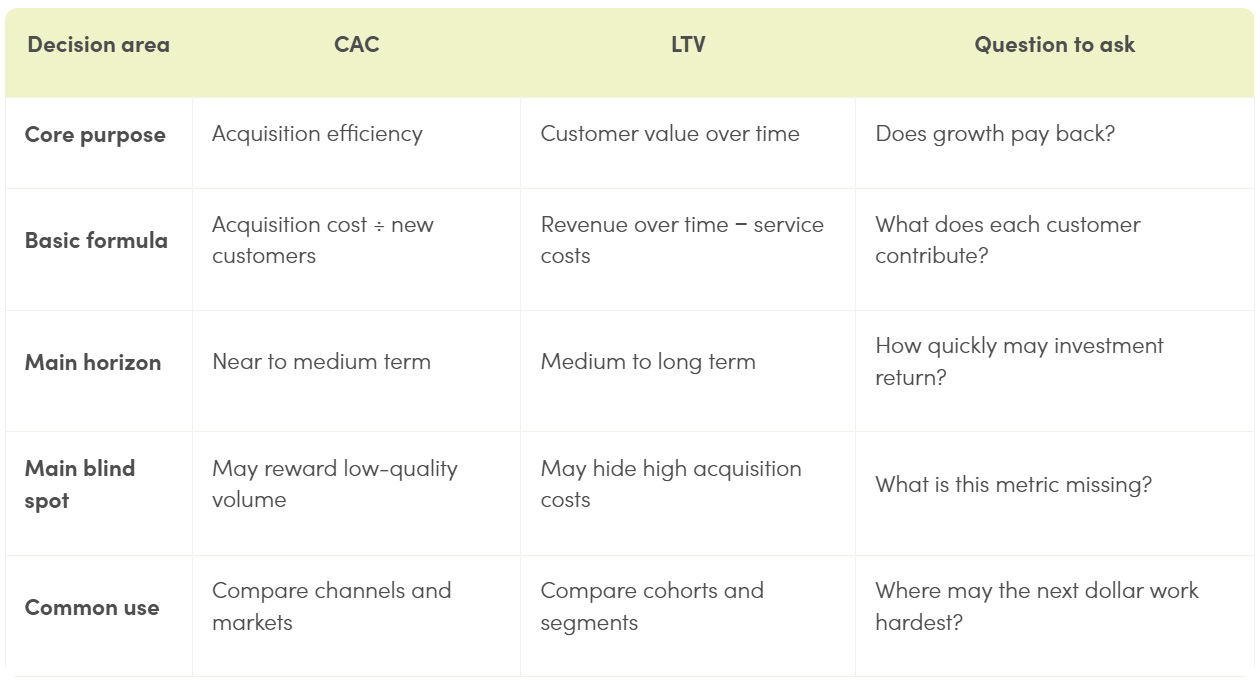
While business leaders often ask whether they should lower customer acquisition cost (CAC) or increase customer lifetime value (LTV), the more useful question may be how the two metrics work together.
CAC measures the cost of growth. LTV measures the value that growth creates.
A low CAC can hide weak customer quality, and a high LTV can look attractive if service costs are not included. To accurately track whether a firm is experiencing sustainable growth, tracking both metrics by cohort and channel is often more effective than tracking either one independently.
Now, regarding CAC vs LTV prioritization, there are instances wherein CAC may deserve priority, and others wherein LTV may deserve it. This report breaks down how customer acquisition teams can use both metrics to support durable growth.
Customer acquisition cost (CAC) is the total cost of winning a new customer. A standard calculation divides sales and marketing costs by the number of new customers acquired in the same period.¹ CAC can help leaders assess whether a growth channel may be efficient enough to scale, but it’s only one side of the equation.
Customer lifetime value (LTV) is an estimate of what a customer may contribute during the relationship. A practical model can include average revenue, expected lifespan, and the costs required to serve the account.² LTV can therefore reflect retention, adoption, expansion, and service quality, but it is primarily a measure of the amount of money taken in for a single average customer over the entirety of a business relationship.
CAC asks what it costs to create a customer relationship, while LTV estimates what that relationship may be worth over time. Looking at the two metrics together can give leaders a clearer picture of whether growth is creating durable value or simply adding customers who may not stay long enough to pay back what it cost to acquire them.
CAC may deserve priority when a company is deciding whether it can afford to scale. If acquisition costs rise faster than profit margin, growth may consume cash even while revenue increases. This may be especially important to monitor when a business enters a new market, adds a channel, or increases campaign volume.
A useful starting point may be a “fully loaded” CAC, meaning a calculation that includes both direct and indirect costs associated with acquiring a new customer. These costs may include media, sales labor, commissions, technology, onboarding, partner fees, travel, and other acquisition-related expenses.
A narrow CAC calculation may make one channel appear more efficient than it is if some costs sit with another team. That can overstate ROI and lead to investment decisions based on incomplete information.
These warning signs point to a broader question: Can the company explain how the next customer may pay back the cost of acquiring them? CAC may deserve priority when that answer depends on uncertain assumptions or incomplete cost data.
A higher-CAC channel may still be reasonable if its customers remain longer, require less support, or expand their relationship. Comparing fully loaded CAC with cohort-level LTV can help determine whether the added acquisition cost may be justified.
LTV may deserve priority when acquisition appears efficient but customers do not stay, adopt, renew, or expand. A customer who leaves before the business recovers its acquisition cost could reduce the value of an otherwise strong campaign. Salesforce describes LTV as a lens into customer satisfaction, adoption, churn risk, and long-term profit.²
Customer quality, therefore, becomes a financial issue. A prospect may convert but still end up appearing like a “weak” customer fit if the offer was unclear, expectations were misaligned, or the handoff was poor.
Retention can also influence profit. Bain has cited research showing that a 5% increase in retention may increase profits by 25% to 95%, depending on the business.³ The range should not be treated as a universal forecast, but it illustrates why retention may belong in acquisition decisions.
Human conversation may also matter when a purchase involves trust, complexity, or a long-term commitment. SurveyMonkey reports that 79% of Americans strongly prefer talking with a human over an AI agent, while 89% believe companies should offer the option to speak with a human.⁴ These findings do not mean every interaction should be manual. They may suggest that removing human access can create a customer-quality risk.
A successful operating model usually combines acquisition cost, customer value, payback speed, and customer quality to paint a more holistic financial picture. Reviewing these measures by cohort may provide more insight than relying on one company-wide average.
A commonly utilized LTV:CAC benchmark is 3:1, meaning expected customer value is three times acquisition cost.⁵ The ratio is widely used in subscription and SaaS businesses, and it can also serve as a helpful screening tool in other industries. Because margins, sales cycles, service costs, and capital needs vary widely, 3:1 is best treated as a starting point for evaluation rather than a fixed target.
Field sales, residential outreach, and event programs can offer a unique balance between CAC vs LTV. These channels may involve more upfront sales effort than lower-touch acquisition methods, but face-to-face conversations can give representatives more opportunity to explain the offer, answer questions, and assess customer fit before enrollment.
That added context can support LTV by helping reduce mismatched expectations and early drop-off. At the same time, outsourcing in-person acquisition can help brands manage CAC by expanding into new markets without building that capability internally.
Cydcor delivers outsourced, in-person customer acquisition across residential, retail, B2B, and event channels in the US and Canada, with campaign design, client reporting, and compliance oversight built in.⁶ For enterprise brands, this combination may provide a practical way to pursue acquisition volume while keeping customer quality and long-term value in view.
“CAC vs LTV” is a false dichotomy. These metrics offer two equally vital perspectives of the same growth analysis. CAC shows what the company spends to create a customer relationship. LTV estimates whether that relationship may generate enough value to justify the investment.
Leaders may consider lowering CAC when acquisition is inefficient, improving LTV when fit is weak, and preserving human connection when trust affects retention. Cydcor’s face-to-face customer acquisition model is designed to help brands balance customer acquisition cost with long-term customer value. Because in-person conversations give customers a chance to ask questions and understand an offer before they enroll, this approach can support stronger customer fit, which may help improve retention over time.⁶
For a customer acquisition strategy built around measurable execution and long-term customer value, Explore a Cydcor Partnership.

Door-to-door sales can be a great strategy for opening up new residential markets or pushing a new product, but its success rate depends on more than adding the right number of field sales reps. Well-planned field sales programs connect market planning, local rules, field training, and measurement to shift the odds in their favor. This makes investing in field marketing a more predictable and reliable driver of revenue instead of a costly gamble.
The sales model below turns a broad canvassing effort into a repeatable sales program:
Select territories based on the residents behind the door, not just the broad demographic of a neighborhood. Define the homes, service rules, income bands, home types, or other signals that make a location relevant. Then layer in useful constraints, such as travel time, access, weather, working hours, and expected contact rates to further distill the highest-value territories to target.
A market plan should produce more than a list of streets by defining the order of areas, daily route load, contact details for issues, parking guidance, and the handoff process for leads that need follow-up. This can help protect selling time and give managers a steady way to compare markets.
One of the higher performing field models is as a national reach with local work, supported by a network of independently owned sales companies and assigned program support. That combination can be useful when a brand needs one operating standard across markets without ignoring local rules.
Relevance matters at the door, so use buyer data, service access, prior campaign results, and local knowledge to rank areas before launch. A broad footprint can create activity, but a focused footprint creates learning.
Build a simple market score with four inputs: buyer fit, reachable homes, competitive rules, and field readiness. Keep the score visible to field leaders. When results change, managers can see whether the issue is the offer, the area, the route, or the execution.
It’s also good to remember that a “no” isn’t a net-zero outcome. Record why the household declined, whether the service was not available, and whether a better follow-up time exists. Those signals can improve the next route and help marketing teams add value to the wider acquisition message.
Compliance is part of the customer experience. Before a team enters a market, confirm solicitation rules, registration or permit requirements, restricted homes, sign-in procedures, working-hour limits, and any disclosure language. Assign one owner to maintain the market file and one clear contact for field questions.
Badging should be easy for a resident to verify. Use clear names, photos, company identification, campaign details, and a phone or web verification method. Train reps to show credentials without becoming defensive. If a resident asks the team to leave, a good response is a prompt and respectful exit.
Local and federal rules may apply to in-home transactions. Programs should have legal review for the offer, contract, disclosures, and state or local requirements before launch.
A script alone does not prepare a rep. Training should combine product knowledge, role-play, objection practice, privacy expectations, safety guidance, and route procedures. Reps should know what they can promise, what requires approval, and how to explain the next step in plain language.
Use a short talk structure: identify yourself, state the reason for the visit, ask a relevant question, connect the offer to the response, and confirm the next action. The goal is not to force every interaction into a sale. It is to create a clear, respectful path to a good-fit decision. Be sure to make eye contact, be engaging, and bring energy.
Cydcor’s field sales program describes a model in which independently owned sales companies hire, train, and lead reps, while Cydcor’s campaign team shares client needs and rules teams monitor programs. That division of responsibility can offer a useful model for scaling while keeping accountability visible.
Door count is an activity measure, not a growth strategy. Track the full path from assigned doors to talks, ability to reach decision-makers, good-fit opportunities, applications, sales, cancellations, and retained customers. Review the numbers by market, campaign, route, and time period.
A useful scorecard should answer three questions each week: Where are we finding demand? Where are buyers dropping out? What change will we test next? Include quality measures, such as complaint rate, documentation accuracy, cancellation rate, and customer feedback, alongside volume and conversion.
A multi-market program can benefit from campaign design, compliance oversight, reporting, and quality oversight. Those capabilities can help maintain a common measurement language, not just separate local reports.
Expand only after the first market produces a repeatable playbook. Document the route logic, approved materials, training sequence, rules checks, reporting rhythm, and local exceptions. Then use that playbook as a starting point, not a rigid script.
Each new market should have a launch owner, a local readiness review, a short pilot, and a decision gate. Continue when quality and unit cost meet the agreed threshold. Adjust when the issue is fixable. Pause when rules, customer experience, or unit cost remain below standard.
This is where a partner such as Cydcor can add scale. Its model offers customer acquisition outsourcing across residential, retail, B2B, and event channels, plus assigned campaign support. For large brands, the value is not simply more people at more doors. It can provide a repeatable system for local work under one brand standard.
Well-planned door-to-door sales strategies can treat field acquisition as a system. Plan markets around buyer fit, prepare for local requirements, train reps for real talks, measure quality through the full funnel, and scale only what can be repeated. With field support and local market knowledge, brands can extend home sales while protecting a consistent customer experience.

When an organization enters new markets, the choice between inside vs. outside sales can affect far more than staffing. Making the right decision can significantly improve how prospects experience the brand, how quickly the team can expand, and how much fixed cost the company must carry. Inside sales prioritizes remote engagement, while outside sales brings representatives into the markets and environments where customers make decisions, and each has a potential role to play in every business’s sales and marketing infrastructure.
As a result, for many enterprise brands, the answer is not choosing one model permanently. It is matching each channel to a specific customer, offer, territory, and/or acquisition goal. This guide compares the two approaches across a few different planes of observation to get a better idea of where each can be most effective, and when using both may be necessary to maximize value.
Inside vs. outside sales is about where and how the selling happens: Inside sales typically involves a rep selling remotely by phone, email, or video from an office or other dedicated workspace. Outside sales refers to reps selling face-to-face, generally meeting the customer where they are in a setting like their home, a store at which they shop, their business, or an event they attend.
The table below breaks down the different approaches used by inside and outside sales across the most common decision factors:
As outlined above, the decision becomes much easier once you identify your ideal customer. A prospect who prefers a quick online conversation may respond well to inside sales, while a shopper, homeowner, or business owner may prefer to have an in-person relationship with someone attached to your company before making a purchase.
Inside sales generally works well when a company needs broad coverage, frequent follow-up, or a controlled sales process. Since representatives can work from a central location, the team can communicate with prospects across multiple markets in a standardized manner without needing staff in the field. Inside sales can also be good for long sales cycles, since it makes it easier to balance a high-volume of low-touch accounts in a consistent way.
This model is usually stronger when buyers prefer a quicker or lower-touch sales process, making them more comfortable with remote communication. This is typically the case in industries where the offer is easy to explain, and customer data is organized well enough to support quick routing and follow-up. It can also support longer sales cycles by keeping prospects engaged between meetings without overwhelming them, and handling documentation after a field conversation in instances where both are leveraged.
The limitation is context. Remote conversations may not reveal local objections, physical buying conditions, or the customer’s full environment. When trust, education, demonstrations, or local access influence conversion, a remote interaction may not be enough proof of value for many prospects.
Outside sales gives representatives direct access to the people and places where buying decisions happen. A field representative can answer questions in real time, adapt to the conversation, and notice details that might never appear in a CRM record. That direct engagement is especially valuable when customers need confidence and/or trust before they commit.
Outside sales is often a strong fit for more complicated products that require explanation, customers who are difficult to reach digitally, and markets where understanding of the locality affects the relevance of a product. It also gives brands a way to create more memorable interactions while gathering firsthand feedback about customer needs and objections.
Cydcor operates in-person customer acquisition programs across residential, retail, B2B, and event channels. Its outsourced customer acquisition services reflect the different environments where customers live, shop, work, and gather. They offer specialized support based on the industry of their clients, and connect them with customers that fit their ideal profile. As an outsourced sales and customer acquisition partner, Cydcor tailors each program to the client's industry, products, and target customers, so brands get field sales without having to build that capability in-house.
Residential programs can help brands reach homeowners directly, while retail teams can demonstrate products and guide shoppers toward a purchase. In B2B settings, representatives can visit small and mid-sized businesses that are difficult to reach through telesales, opening conversations with decision-makers in their own environments.
Comparing salaries alone does not reveal the true cost of a sales model. Leaders should consider recruiting, training, technology, travel, management, benefits, compliance, and the time required to build a productive team.
Inside sales generally reduces travel and field expenses, while outside sales may require more coordination to manage territories and local execution. However, outside sales can reach customers and markets that remote teams struggle to access, which makes the higher operating complexity worthwhile in the right circumstances.
An outsourced outside sales model can change that equation. Rather than building every field capability internally, an enterprise brand can partner with an established network. Cydcor’s operating model gives brands access to independently owned sales companies across North America, and their broad sales network with the scale to support Fortune 100 companies.
Cydcor’s business model explains that Cydcor pays sales companies based on measurable outcomes, such as customer sign-ups or closed sales, although compensation structures vary by program. Programs are also built around the client's brand standard, which helps differentiate the brand from competitors and impact the customer's experience.
That approach may reduce fixed hiring exposure for the brand. It does not eliminate cost or risk, so agreements still require clear performance definitions, pricing, compliance standards, reporting, and brand protections. For companies entering new markets, it can provide a way to test demand before committing to a permanent internal field organization.
Outside sales depends on more than placing representatives in front of customers. Results also require preparation, consistency, resilience, coaching, and accountability. Cydcor’s model uses independently owned sales companies that recruit, train, and manage their own teams while remaining accountable for campaign performance and standards.
That structure creates a direct connection between ownership and execution. Cydcor’s network of independent sales companies emphasizes qualities such as grit, student mentality, coachability, mentorship, and consistency, all of which matter when representatives must earn trust in the field and adapt to different customer situations.
For enterprise buyers, motivation should support the process rather than replace it. A strong program connects performance expectations with training, compliance oversight, reporting, coaching, and a clear feedback loop from the market.
The best model depends on the customer journey rather than a general preference for remote or in-person selling. Inside sales may be the better starting point when the priority is efficient follow-up and broad outreach, while outside sales may be the better choice when local access, trust, and direct engagement drive conversion.
A hybrid model can combine both strengths: inside sales can qualify opportunities and manage follow-up, while outside sales creates the direct interaction that moves a prospect toward a decision. Both teams can then share customer feedback, performance data, and market intelligence.
For enterprise brands, the key question is which customer interactions require human presence, and which steps can happen efficiently through remote engagement.
The same framework applies to Cydcor’s customer acquisition services, event services, and residential, retail, and B2B programs.
Inside vs. outside sales doesn’t have to be a complicated choice. Inside sales offers efficiency, centralized control, and broad remote reach. Outside sales offers direct engagement, local access, and relationship-building in the environments where customers make decisions. For residential, retail, and B2B acquisition, outside sales can be especially valuable when trust, timing, education, or physical presence affects the purchase.
Cydcor helps enterprise brands build and manage in-person outside sales programs across these channels. Its outsourced, performance-oriented model gives brands access to field sales capacity without requiring them to assume every fixed cost of building an internal team. The right strategy may combine both approaches, using remote engagement where it improves efficiency and outside sales where human presence can strengthen acquisition and market reach.
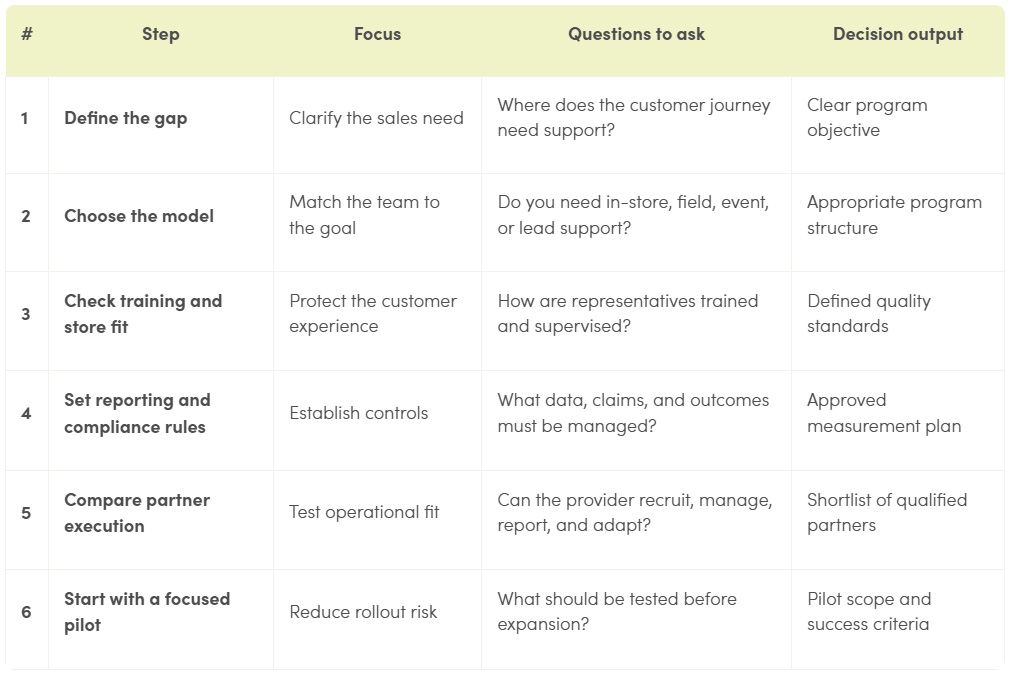
While many smaller brands express some worry when it comes to outsourcing sales, it has proven to be a reliable way to break into new markets, deploy new products, or even just supplement an existing sales team. Retail sales outsourcing can add trained staff and field support without requiring a full internal build, which is made especially effective when you choose an outsourcing partner that knows how to work within retail environments and represent a brand within a store/retailer’s culture.
The key is finding the right outsourcing partner and model, which depends on the customer journey, store setting, compliance needs, and reporting plan. This guide breaks down where an outside team may help, and what to review before choosing a partner.
“Retail growth depends on delivering consistent customer experiences wherever buying decisions happen.”
As with any sizable business investment, decision makers should start with the problem. Figure out whether your biggest sales need is getting more product help at the shelf, wider store coverage, help breaking into new markets, or a quick increase in headcount to push a new product.
Outsourcing generally best fits work that is local, specialized, or hard to staff; it doesn’t need to be all of these things at once, though. It may also support an internal team instead of replacing it. In the end, the need must define the role of your outsourced sales partner.
Retail sales outsourcing may include in-store teams, field teams, or event teams. In-store staff can explain products, run demos, answer questions, and even sell themselves. Field teams can cover several locations. Event teams can support pop-ups, sampling, trade shows, and launches.
Some programs use more than one model. A launch could use event staff for awareness and in-store staff for product education and sales conversion.
Representatives are a visible part of the brand whether they are in-house or outsourced. Ask how the outsourced staff are trained on product details, approved claims, store rules, customer questions, and escalation steps to ensure they have enough runway for a successful deployment. It may also be helpful to inquire about what comparable brands they’ve worked with.
Training should fit the store. Staff need a clear message regardless of setting, but they also need room to answer real questions in a way that doesn’t feel rushed or rehearsed if they are in an environment where they’ll be dealing with a low volume of potential customers that want longer or more in-depth engagements. A single script may not work in every store or with every shopper.
Retailers should confirm how training is inspected, updated, and checked in the field. They should also ask how the provider handles product changes, store-specific rules, and customer concerns. Both of these play a key role in ensuring that value is maximized across every sales setting, and working with a quality outsourcing partner that truly understands the important nuances of representing a brand within a retail environment. The best do this by working alongside store employees and management, rather than just taking a post in a designated area and approaching prospects in an isolated manner, disconnected from the rest of the shopping experience.
Set a program goal before choosing reporting measures, so you know exactly what it is you’ll be reporting. An education program may track demos, questions, and feedback since the goal is simply to increase awareness or dispel initial customer concerns. A customer-acquisition program is more likely to strictly track leads, purchases, and/or handoffs. An event program may rely more on engagement and follow-up data that is indicative of a future purchase in industries with longer sales cycles.
Ask how data is collected, checked, shared, stored, and deleted. Clarify who owns customer data, and set a process for complaints and hard questions.
Finally, the Federal Trade Commission says advertising claims must be truthful, not misleading, and supported by evidence.¹ Retailers should review claims, disclosures, offers, and data practices with the right legal and compliance teams to avoid unnecessary liability.
A client list is only one part of the review; you should also ask how the provider recruits, trains, schedules, supervises, and reports on the team and compliance processes. Also, ask how it handles store coordination and program changes.
Compare each provider’s stated services with your campaign's needs by asking for examples that match your store type, customer, sales cycle, and market.
Review whether the partner can support the full operating process. That may include recruiting, training, scheduling, field supervision, reporting, and adjustments during the program.
A pilot can test the relationship before a wider rollout. Set the locations, dates, audience, training, reports, and review points in advance. Include a clear way to pause or change the work. Information from the right partner who is in the store can help perfect the pitch and enhance the customer experience with a brand.
The pilot should answer practical questions. Can the team represent the brand clearly? Does the data support decisions? Do store partners accept the model? Can the provider adjust while keeping the message consistent? Your outsourcing partner can help test these and refine them before sales reps are trained.
Goal setting should be part of the first discussion, whether you choose Cydcor or another provider. Define what the team will do, how performance will be reviewed, and what conditions would support expansion.
Retail sales outsourcing can help add customer-facing capacity for product education, market entry, event work, or customer acquisition. The right approach depends on your customer journey, retail environment, operating needs, and risk controls.
Before choosing a provider, confirm that the program has a clear scope, trained representatives, reliable field oversight, defined reporting, and appropriate compliance controls. A focused pilot can also help your team assess the model before a wider rollout.
Ready to explore whether outsourced retail sales support fits your growth goals? Get in touch with Cydcor about your retail customer-acquisition program.

This report on customer acquisition cost by industry uses data drawn from industry benchmark reports, B2B marketing analytics studies, and published third-party datasets covering more than 20 industries. Customer acquisition cost is calculated as total sales and marketing expenditure divided by the number of new customers acquired during a defined period. Using this data, we observe how CAC varies by industry, company size, and acquisition channel, as well as what those variations mean for enterprise organizations when building their growth strategy.
CAC varies by more than 13x across B2B industries,2 reflecting fundamental differences in sales cycle length, competitive density, regulatory burden, and the degree of relationship development required to close a sale. The table below draws on First Page Sage's analysis of client marketing analytics data gathered between January 2022 and August 2025, segmented by organic and inorganic acquisition channels and combined into a weighted average.2
Source: First Page Sage, "Average Customer Acquisition Cost (CAC) By Industry: B2B Edition," January 26, 2026 2
Key findings from this dataset:
The customer segment and ticket size being targeted has as much impact on CAC as the industry itself. Across B2B industries, CAC increases by more than 7x from the small business tier to the enterprise tier, driven by more decision-makers, longer sales timelines, and more complex procurement processes.5 The following table, drawn from First Page Sage's B2B SaaS CAC benchmarks, shows how acquisition cost scales with customer size across 12 industries.3
Source: First Page Sage, "B2B SaaS Customer Acquisition Cost: 2025 Report" 3
Key findings from this dataset:
Not all high CAC is the same. Two industries can share a similar acquisition cost for entirely different structural reasons, and the right response to each is different. The table below maps key industries to the primary factors responsible for their CAC levels, based on analysis of published benchmark research.
"Customer acquisition costs are most meaningful when evaluated alongside customer lifetime value, buying complexity, and growth objectives."
Source: Cydcor research team analysis based on First Page Sage (2026),2 Userpilot (2026),5 and Vena Solutions (2024)12
Key findings from this dataset:
How quickly a company recovers its acquisition investment is as important as the investment itself. An enterprise-level CAC is sustainable when the resulting customer contract generates enough revenue to return that cost within a reasonable timeframe. According to Optifai's Sales Ops Benchmark of 939 B2B SaaS companies, a payback period under 18 months is generally considered healthy, and under 12 months marks best-in-class efficiency.7 The table below draws on First Page Sage's CAC payback benchmarks, based on 50+ SaaS companies tracked over 13 years.4
Source: First Page Sage, "SaaS CAC Payback Benchmarks: 2025 Report" 4
Key findings from this dataset:
No CAC figure is high or low in isolation. A $10,000 enterprise acquisition cost is sustainable when the resulting customer relationship generates $40,000 or more in lifetime value. A $500 CAC is unsustainable when the average customer churns after one transaction generating $400 in margin. The LTV:CAC ratio, which divides customer lifetime value by customer acquisition cost, is the standard tool for evaluating whether a given acquisition program is economically sound. A pattern across published benchmarks indicates around a 3:1 LTV:CAC ratio as the healthy baseline for many B2B businesses.9,10,11
Source: YourGrowthPartner, "Customer Acquisition Cost (CAC) Benchmarks by Industry: 2025 Data" 9
Key findings from this dataset:
CAC benchmarks are more useful as a diagnostic than they are as a destination. Knowing where your industry average sits tells you whether your spend is in range, but not whether your acquisition model is built for the customers you are actually trying to win. The more illuminating questions are whether your CAC reflects your target segment's buying complexity and whether your current channels can reach the decision-makers your deals depend on.
For enterprise organizations in sectors with long sales cycles and high stakeholder counts, the data here points toward a consistent pattern: relationship-driven acquisition often produces lower relative cost and higher customer quality than digital-only approaches, because the buying process requires human contact to advance. Cydcor's outsourced field sales network is built for that environment, delivering a performance-based acquisition model through direct, in-person engagement across North America.
For organizations looking to improve customer acquisition efficiency without sacrificing customer quality, get in touch with Cydcor to learn more.
Last updated: September 2026

Enterprise growth rarely comes from adding more channels at random. It comes from building a customer acquisition process that connects business goals, buyer behavior, execution capacity, and measurable outcomes.
That matters even more as buyers move between digital research, AI tools, sales conversations, events, referrals, and in-person interactions. McKinsey reports that B2B customers now use an average of 10 interaction channels during the buying journey, up from five in 2016.¹
“The strongest enterprise customer acquisition processes align acquisition methods with customer behavior, business goals, and long-term growth.”
This guide explains how enterprise leaders can build a scalable customer acquisition process without overcommitting to any single method.
A customer acquisition process should begin with a concrete outcome by which success will be measured. Enterprise leaders may want to enter a new market, increase market share, acquire higher-value accounts, improve regional coverage, or create a more predictable pipeline.
Each objective requires a different process; A market-entry program may prioritize geographic reach and speed, an account-based program may prioritize stakeholder mapping and opportunity quality, and a volume-focused initiative may emphasize conversion efficiency and repeatable execution.
The objective is then used to determine the criteria for success, including the KPIs that can be used as proof points.
The strongest objectives include a time frame, target segment, revenue expectation, and operating constraint. For example: “Acquire 2,000 qualified business accounts in three regions within 12 months while maintaining a CAC payback period below 12 months.”
Enterprise audiences are rarely single groups. A buying committee may include an executive sponsor, technical evaluator, finance leader, procurement team, and/or an end user. Each person may have different concerns, information needs, and preferred marketing channels.
Build audience definitions around customer behavior rather than demographics alone. Identify the problem each segment is trying to solve, the event that may trigger a purchase, the objections that slow progress, and the evidence required to build confidence.
This buyer journey also determines when human interaction adds value. Gartner found that 69% of B2B buyers prefer to validate AI-generated insights with sales representatives. At the same time, 67% prefer a sales rep-free experience, and 70% prefer a fully digital, self-service experience.²
These findings support a balanced process. Digital content can help buyers research independently, while skilled representatives can provide context, reassurance, and decision support at critical moments.
No single acquisition channel performs equally well across every segment, market, or growth stage. A scalable process assigns each channel a clear job and/or a conditional use case.
Owned channels (such as search, email, and educational content) can support efficient research and demand capture. For example, paid media can accelerate reach when targeting and conversion paths are clear while partners and referrals can transfer trust. Account-based outreach can focus resources on high-value prospects and Events and in-person acquisition can create direct conversations where products require explanation, local presence, or relationship-building.
Cydcor’s model illustrates how relationship-driven acquisition can fit into a broader strategy. The company describes customer acquisition programs across B2B field sales, retail, events, and residential outreach, supported by a network of hundreds independently owned sales companies.³ That makes in-person acquisition a flexible component for specific audiences and objectives, rather than a replacement for digital or owned channels.
Evaluate channels using the same commercial standards. Compare qualified opportunities, conversion rates, sales-cycle length, CAC, customer quality, and payback period across each one of them, and think critically about what you find. A channel that produces fewer leads may still be the better investment if it produces higher-value customers, as long as your initial objective doesn’t necessitate a high volume of new customers.
A strategy becomes a process when people can execute it consistently. Define how campaigns are planned, launched, monitored, improved, and expanded and ensure individual roles and scope are clear.
Your operating model should establish ownership across marketing, sales, finance, operations, legal, and customer success, and should also document handoffs. A campaign can generate strong demand but still underperform if leads are not routed quickly, representatives lack the right training, or customer data does not flow back into the CRM. Documentation of handoffs can help identify where in the process either the operating model, or your staff’s understanding of their role within it, intervention may be needed.
For enterprise programs, governance is part of growth. Brand standards, consent practices, reporting rules, and escalation paths should be designed before launch. This is especially important when multiple teams, agencies, territories, or local operators represent the same company, or when outsourced sales is on the table.
A mature customer acquisition process measures more than activity. Impressions, meetings, and leads can help diagnose or predict performance, but they do not prove profitable growth on their own.
Create a measurement framework that links channel activity to pipeline, closed revenue, retention, and expansion. Then, segment results by audience, geography, product, campaign, and acquisition source. This helps leaders see where performance is strong and where a blended average is hiding problems.
Review results at three levels:
The goal here is to identify the combination of channels and operating practices that produces durable growth.
An effective enterprise customer acquisition process gives every channel a defined role. It begins with business objectives, reflects how target buyers make decisions, includes the right mix of digital and human interactions, and uses consistent measurement to guide investment.
For organizations that need to expand market coverage, reach difficult-to-access prospects, or add relationship-driven acquisition capacity, Cydcor offers in-person customer acquisition programs designed to work alongside broader go-to-market strategies.³ ⁴
Explore Cydcor’s Customer Acquisition Services

Enterprise brands rarely grow by relying on one customer acquisition channel. The harder question is how those channels should work together.
Multichannel marketing uses several channels to reach customers, but each channel may operate independently. Omnichannel marketing, on the other hand, connects those channels so customers experience one coordinated journey across digital, physical, and in-person touchpoints.¹
The difference matters when a prospect moves from a paid ad to a website, speaks with a sales representative, visits a retail location, or responds to an event promotion. A multichannel strategy can create reach, while an omnichannel strategy connects that reach to a more consistent customer experience.
The omnichannel marketing vs. multichannel marketing comparison begins with a company’s priorities for their marketing campaign. Multichannel focuses solely on being present across as many platforms as possible, while omnichannel marketing focuses on what happens as customers move between those platforms.
A multichannel program might use email, social media, paid search, retail, and field sales at the same time, but each channel may have its own goals, audience segments, reporting, and creative direction.
That structure can be useful, since teams can test channel-level performance without waiting for complete data or technology integration. However, customers may receive inconsistent messages or repeat information when they switch channels.
An omnichannel model treats those interactions as connected parts of one journey to turn all marketing touchpoints into a continuous, unified customer experience.¹ This should be the eventual end-goal of any comprehensive marketing campaign.
Both strategies can support customer acquisition, but their strengths differ in how they manage the relationship after the first interaction.
Multichannel marketing is often the simpler and more cost-effective starting point for organizations building channel coverage. It can help a brand identify where prospects respond, which messages perform, and which markets deserve more investment before creating a ground-up strategy that forces commitment.
Omnichannel marketing becomes more valuable as the buying journey becomes more complex. Customers may research online, ask questions through a sales team, compare options in person, and complete the purchase through a different channel. This makes it prudent to consider what stage in that buyer journey each marketing channel most often plays a role, and how it impacts the likelihood of an eventual purchase.
McKinsey notes that effective omnichannel marketing integrates channels around customer preferences and needs. Its research also links successful omnichannel personalization with a potential 5% to 15% revenue increase across the customer base.² This stresses the idea that it isn’t just about increasing visibility across channels, but coordinating that visibility in a way that puts the buyer journey on the path to a sale.
In-person acquisition is not the opposite of digital marketing. It can serve as the human interaction that makes a broader omnichannel journey more useful.
A prospect may see a digital ad but still need a product explanation, a live demonstration, or an answer to a specific objection. Face-to-face engagement can provide those interactions in real time.
The strongest omnichannel programs define how in-person teams connect with digital activity before, during, and after each interaction.
For example, an enterprise brand could use digital media to promote a service in a target market, then use trained representatives at retail locations or events to engage interested prospects. This allows follow-up communications to continue the conversation instead of treating the interaction as an isolated event, and offers in-person sales reps warmer leads.
McKinsey identifies physical and digital coordination as a major part of omnichannel personalization. It also emphasizes the need to connect digital and physical footprints and align frontline teams with the broader customer experience.³
Enterprise growth rarely comes from relying on a single channel. Face-to-face customer acquisition complements digital marketing by creating direct customer interactions that strengthen an omnichannel strategy.
The right choice depends on the organization’s objectives, data maturity, and customer journey.
Prioritizing multichannel marketing does not mean ignoring customer experience. It means establishing a focused presence before connecting every touchpoint.
Prioritizing omnichannel marketing does not mean using every available channel. It means choosing the channels that matter to the customer and connecting them around clear journey stages.
Enterprise brands should also avoid treating omnichannel as solely a technology project. It requires shared goals, consistent messaging, reliable reporting, and teams that understand how their interactions affect the next step.
Start with the journey instead of a channel list. Identify the moments when customers discover the brand, evaluate an offer, request information, speak with a representative, and decide whether to move forward.
Then, it’s time to define the role of each touchpoint.
Cydcor’s campaign process begins with understanding a client’s business goals, target customers, geographic priorities, compliance requirements, and success metrics. Cydcor then matches campaigns with sales companies based on market coverage and relevant experience.
That type of structure can help enterprise brands add face-to-face acquisition without creating a disconnected side program. In-person teams become part of the customer journey, while digital channels support awareness, follow-up, measurement, and retention.
Multichannel marketing helps enterprise brands reach customers across several platforms. Omnichannel marketing goes further by connecting those interactions into a more consistent journey.
The strongest strategy may use both. A brand can begin with focused multichannel testing, then connect high-value touchpoints as customer movement, data, and operational needs become clearer. Face-to-face acquisition adds a valuable human layer, particularly when customers need explanation, trust, or real-time guidance.
Cydcor helps enterprise brands build in-person customer acquisition programs across B2B field sales, retail, events, and residential outreach. Those programs can complement digital marketing and support a broader omnichannel growth strategy.
Talk with Cydcor about your customer acquisition goals

Cydcor recently sat down with Andy King, President of Federal Publications Seminars (FPS), FPS is a leader in federal contracting compliance training with over 65 years of experience, hundreds of trusted industry experts, and the largest content library in market. At Cydcor, we connect leading brands with customers through face-to-face sales campaigns, and compliance monitoring is built into how every campaign is managed. Few markets demand more compliance discipline than government contracting. So we asked Andy what regulated industries can teach any organization that wins business on trust.
Q: You teach government contractors how to stay compliant. Why should sales-driven organizations pay attention?
A: Because compliance determines who is allowed to compete. In government contracting, a company that cannot demonstrate compliance with the Federal Acquisition Regulation, or FAR, cannot win the contract. The same dynamic exists in telecom, home services, energy, and financial products. Buyers choose partners that can prove they follow the rules, and regulators can remove you from the market if you cannot. Compliance is not overhead. It is necessary to sell.
Q: From what you have seen in government contracting, what separates companies that treat compliance as an advantage from those that treat it as a checkbox?
A: Among the contractors we work with at Federal Publications Seminars, three habits stand out. They train continuously instead of once a year, because regulations change faster than an annual refresher can capture. They push knowledge to the people making frontline decisions rather than keeping it inside the legal department. And they document everything, because regulators consistently distinguish between a compliance program that exists on paper and one that demonstrably works. None of that is unique to government contracting. It is simply what disciplined organizations tend to do.
Q: Federal rules are changing quickly right now. How does Federal Publications Seminars keep the contractors it trains current?
A: This is the busiest regulatory period we have seen in decades. The federal government has proposed rewrites to large portions of the FAR, and agencies are already operating under deviations while those rules are finalized. At Federal Publications Seminars, our team tracks the Federal Register, agency supplements, and case law, and we update our curriculum as each change lands. That is our job, and we have been doing it for government contractors for more than 65 years. The transferable lesson for any organization is simpler: someone has to own regulatory change, or every change becomes a surprise.
Q: Cydcor’s model is built on human connection. Does compliance ever conflict with relationship-driven selling?
A: It strengthens it. Face-to-face selling works because the customer trusts the person in front of them. A representative who knows the rules can answer hard questions on the spot, set accurate expectations, and avoid promising anything the company cannot deliver. We see the same pattern in government contracting: the contractors with the strongest compliance reputations are the ones who get invited back. Trust compounds. Compliance is how you protect it.
Q: What is your advice for leaders who want to build that discipline into their organizations?
A: Start with roles, not rules. Map what each role must know to do its job compliantly, and train to that map. Choose accredited training where it exists, because accreditation forces rigor. Then measure application rather than attendance: can your people spot the issue when it appears in real work? Organizations that operate this way stop treating compliance as a cost center. It becomes part of how they win.

A Structured Framework for Evaluating Outsourced Sales and Customer Acquisition Partners
"A structured RFP helps organizations evaluate customer acquisition partners more consistently and objectively."
Selecting a customer acquisition partner is a high-stakes decision. The wrong choice can damage your brand, waste acquisition budget, and delay growth by months. The right partner should function as a trusted extension of your go-to-market team, one that delivers measurable results, protects your brand in every customer interaction, and scales with your business.
There is no one-size-fits-all program: the right partner should be able to tailor its approach to your brand, industry, and target markets rather than applying a single standard playbook to every client.
This template gives procurement teams, VP-level buyers, and cross-functional evaluation committees a consistent framework for issuing, scoring, and comparing proposals from outsourced customer acquisition providers. It covers six critical evaluation categories: company experience, service delivery, scalability, reporting, governance, and commercial terms.
Complete the bracketed fields in each section before distributing to prospective providers. Use the scoring matrix in the next section to evaluate responses against a standardized rubric.
This template is appropriate for organizations that are:
This matrix gives your evaluation team a single-view summary of what matters most and how to weight each category during scoring. Assign weights based on your organization's priorities before distributing the RFP.
Scoring Guide:
Note for evaluators: Weigh governance and brand compliance at a minimum of 10% regardless of budget pressure, or even as a pass/fail criterion. A provider who cannot demonstrate consistent brand protection is a liability at any price point.
Complete this section before distributing the RFP. Prospective providers use this context to tailor their proposals to your specific situation.
Issuing Organization: [YOUR COMPANY NAME]
Primary Contact: [NAME, TITLE, EMAIL, PHONE]
RFP Issue Date: [DATE]
Proposal Submission Deadline: [DATE]
Anticipated Program Start Date: [DATE]
Program Scope: [Brief description of the customer acquisition challenge you are solving]
Target Geographies: [List states, regions, or markets you need covered]
Target Customer Segments: [Describe the customers you need acquired: residential, SMB, enterprise, etc.]
Industries Served: [Your company's industry and the industry of your end customers]
Annual Acquisition Volume Target: [Number of new customers you expect to acquire per year]
Current Acquisition Channels in Use: [List existing channels: digital, direct mail, in-person, etc.]
Evaluation Timeline:
This section evaluates whether the provider has the institutional depth, industry knowledge, and client history to serve your organization at scale.
Instructions to Vendors: Provide complete, verifiable responses to each question. Include supporting documentation such as case studies, client references, or certifications where indicated.
This section evaluates the provider's day-to-day operational capabilities: how they recruit and train representatives, manage campaign quality, and protect your brand in the field.
The B2B sales outsourcing services market is projected to reach $20.5 billion by 2033¹, driven in part by enterprise demand for scalable acquisition capacity. This section evaluates the provider's capacity to grow your program, enter new markets, and flex volume without compromising quality or brand standards.
A customer acquisition partner who cannot provide clear, timely performance data cannot be managed effectively. This section evaluates the provider's reporting infrastructure and commitment to transparency. More than 75% of organizations report that buyers expect faster, more personalized responses from vendors².
Brand protection is non-negotiable. This section evaluates the provider's governance infrastructure, compliance standards, and the controls they use to ensure every customer interaction reflects your brand's standards.
This section evaluates the financial structure of the engagement. Performance-based pricing models are the standard for high-quality outsourced customer acquisition providers and protect enterprise buyers from paying for volume without quality.
Q: How is an outsourced customer acquisition partner different from a staffing company?
A: A staffing company is generally limited to filling headcount. A staffing partner that is also a customer acquisition partner provides a complete operational system: staffing, campaign management, brand compliance oversight, performance reporting, and ongoing optimization. The distinction matters at the governance and accountability level because with a true partner, you have structured performance commitments rather than simply filling a roster.
Q: Should we run a pilot before committing to a full-scale program?
A: Yes, for most enterprise buyers, a pilot is the lowest-risk path to validating a new partner, and enables refinement before launching a full-scale program. A credible provider should support a defined pilot period, typically 60 to 90 days, in a limited set of markets with agreed-upon success metrics before a full rollout commitment. Ask prospective providers specifically what their pilot program structure looks like and what triggers expansion.
Q: What is a realistic timeline from contract execution to active customer acquisition?
A: Timelines vary based on how customized the program needs to be, and generally, more customization requires more time. However, working with a provider that regularly builds tailored programs, rather than applying a single standard playbook, can significantly compress that timeline. For enterprise programs using existing training materials and established brand guidelines, experienced providers can support representative activity within weeks of contract execution. Full program rollout timelines depend on geographic scope, volume targets, and the provider's experience delivering customized programs.
Q: How do we protect our brand if a field representative behaves improperly?
A: Include explicit brand conduct standards and a complaint resolution SLA in the contract. Ask each prospective provider for their documented complaint handling process and the average resolution time for conduct-related complaints. Request references specifically from clients who have experienced a compliance incident to understand how the provider responded.
Outsourced customer acquisition is one of the highest-leverage decisions a growth-stage or enterprise brand can make. The difference between a rigorous selection process and an ad hoc one often determines whether a program delivers strong returns or requires a painful replacement cycle one year in.
This template gives your team a consistent framework for asking the right questions, scoring responses objectively, and protecting your brand throughout the evaluation process. The seven sections above cover the criteria that consistently separate high-performing outsourced acquisition partners from providers who look competitive on paper but fail to deliver at scale.
When you are ready to benchmark a specific provider, Cydcor has served Fortune 500 companies and emerging brands across North America for more than 30 years, delivering face-to-face customer acquisition through a network of independently owned sales companies. Cydcor was named the 2026 Silver Stevie® Award Winner for Sales Outsourcing Provider of the Year, selected by more than 150 senior judges from over 2,100 nominations worldwide.³
Sources

Many enterprise growth teams treat field marketing and demand generation as two distinct phases: first, you create awareness, then you send someone to close. That framing is somewhat outdated, as effective customer acquisition strategies run both strategies at the same time, collapsing the distance between the first impression and the signed contract.
Understanding field marketing vs. demand generation, how each individual discipline actually works, and where they overlap can often be the difference between a pipeline that stalls and one that compounds. Demand generation builds awareness and interest across a broad audience using digital channels. Field marketing engages high-value prospects directly, in person, to accelerate and close the sale.
The direct comparison reflects a clean separation, but in practice, high-performing field teams do not simply pick up where demand gen leaves off.
A savvy field rep creates interest, handles objections, and closes the deal inside a single conversation, executing what many organizations model as three separate funnel stages simultaneously.
Demand generation is the practice of building systematic interest in your brand or solution across a target market. It uses content, paid media, SEO, and email nurture to reach a broad audience, move buyers through an awareness and education phase, and surface intent signals for sales to act on. According to Content Marketing Institute 2026 data, B2B buyers consume an average of 13.4 pieces of content before contacting a vendor, and 67% of the buying journey is now self-directed.¹ Demand gen provides the fuel for that self-directed journey.
Field marketing operates closer to the point of decision. Rather than waiting for a prospect to raise their hand, a field team takes the message directly to the customer: at their home, their business, a retail location, or an event. The interaction is live, two-way, and personal. Questions can get answered in real time, trust can build faster, and the decision can happen on the spot.
Misalignment between these two disciplines often comes down to KPIs that do not speak the same language. Demand gen teams optimize for cost-per-lead and MQL volume while field teams measure customers acquired and close rate. When both report to different leaders using different scorecards, coordination can break down.
Healthy programs bridge the two by defining shared goals at the customer acquisition level. That means demand gen is accountable not just for leads delivered, but for the quality of the territory intelligence and prospect profiles that field teams need to execute efficiently. Field teams, in turn, feed conversion data back upstream to sharpen targeting and content.
"Field marketing and demand generation are most effective when aligned around shared customer acquisition goals."
The conventional model treats demand generation as upstream and field marketing as downstream. That model assumes a prospect needs multiple digital touchpoints before they are ready to speak with someone in person. For many enterprise sales cycles, that is accurate. But for high-volume consumer and SMB acquisition, it is often unnecessary, and it introduces delay.
A well-trained field rep arriving at a prospect's door, retail location, or business is not just closing a lead that demand gen warmed up. They are generating demand in the moment: introducing the problem, framing the solution, demonstrating value, and converting, all within the same interaction. This is not a shortcut. It is a different model of the buying journey, one where a face-to-face conversation replaces the drip sequence.
Program design suffers when brands deploy field teams expecting them to only work 'warm' leads. The most productive field programs work both sides: generating genuine interest from cold contacts while simultaneously closing the prospects who were already familiar with, or considering, products in the market.
Executing field marketing at enterprise scale requires territory coverage, compliance management, and performance reporting across dozens of markets at once. Cydcor provides access to that infrastructure through one of North America's largest networks of independently owned sales companies, connecting Fortune 500 and emerging brands to customers across residential, retail, B2B, and event channels throughout most major North American markets.
What makes Cydcor's model distinct is that demand generation and field sales processes are not separate; they can often happen in the same conversation. A field rep from our network is not building awareness and handing off; they can introduce the brand, qualify the prospect, and close the customer in a single interaction. This is not field marketing as a precursor to sales. It is field marketing that is the sale. Recognized as DIRECTV Dealer of the Year for 10 consecutive years (2016–2025), Verizon's 2025 ACD Wireless Agent of the Year, and an Inc. 5000 honoree in both 2025 and 2026, Cydcor's track record reflects what that model delivers at scale.²
“Field marketing vs. demand generation” really isn’t referring to competing priorities, but to complementary forces that, when aligned around shared acquisition goals, can accelerate every stage of the buying journey. Many effective enterprise growth programs stop treating them as sequential and start running them in parallel. For brands that need field execution at scale, the right partner does not just support demand generation; they generate demand and convert it simultaneously.
Cydcor can help turn market opportunities and leads into sales across retail, residential, and B2B channels. Whether entering a cold territory, converting warm leads, cross-selling new products to existing customers, or supporting retention and renewals, Cydcor’s field teams create demand and advance customers toward action in the same interaction.
Explore a partnership with Cydcor to build a field sales program tailored to your customer acquisition goals
Sources